
See the Solution in Action
Building a Fully Cloud-Native Live Production, End to End
How Layercake with Streamcake, Grass Valley AI-Media and AWS are demonstrating dynamically orchestrated live production at SMPTE Integrate 2026
At SMPTE Integrate 2026 in Sydney, Layercake will demonstrate an end-to-end cloud live production environment built around a simple idea:
Production infrastructure should exist when you need it, scale to the production you are delivering, and not have to sit idle when the production is finished.
Working with Grass Valley, AWS and TAFE NSW, we are deploying a complete live production workflow that takes camera feeds from the event venue into the cloud, produces the program using Grass Valley AMPP, and distributes the resulting content through AWS media services.
Streamcake provides the orchestration and automation layer that brings the environment together.
From the Venue to the Cloud
Live camera feeds from the SMPTE Integrate event at ICC Sydney are transported using SRT into AWS MediaConnect.
From there, the feeds are made available to the Grass Valley AMPP production environment.
The production itself uses Grass Valley Event Producer X, providing the capabilities normally associated with a traditional live production environment, including:
- Vision mixing
- Audio mixing
- Multiviewing
- Graphics
- Clip playback
- Program output
- Automated captions
Grass Valley Framelight X provides the associated media and asset management capabilities, including ingest, metadata, search, content editing, storage and workflow management.
AI-Media LEXI provides automated caption generation and transcription.
The difference is that these production capabilities are operating as software workloads in the cloud rather than being tied to dedicated physical production infrastructure.
Streamcake Orchestrates the Production Environment
Running production software in the cloud is only part of the challenge.
The underlying infrastructure, services, connectivity and production applications still need to be deployed, configured and managed as a coordinated production environment.
This is where Streamcake sits.
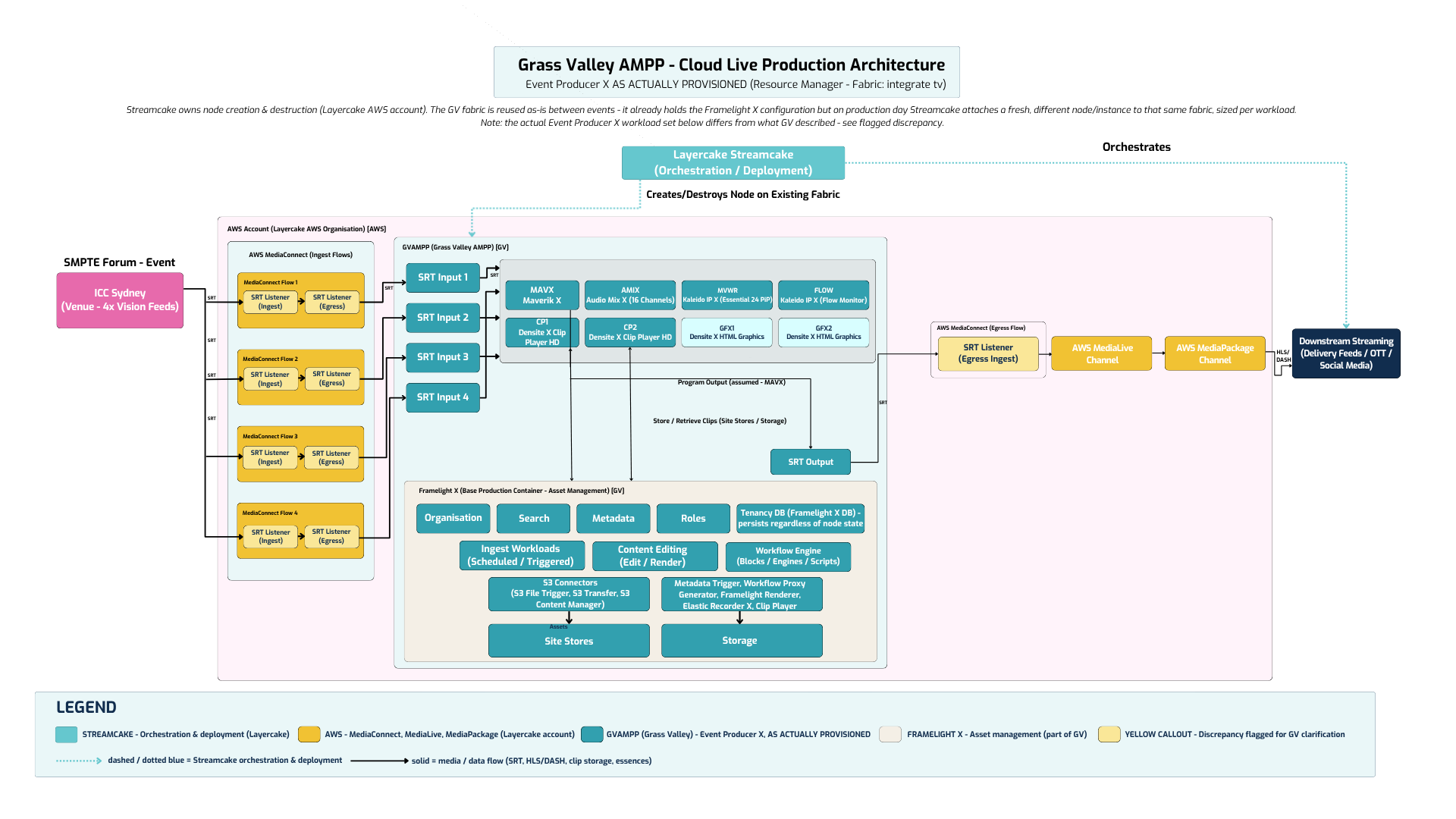
Streamcake provides the orchestration layer used to deploy and manage the production environment, including the creation and destruction of the compute nodes required by the Grass Valley AMPP production.
Rather than treating each application or cloud service independently, Streamcake allows the production to be represented as an operational workflow.
The process becomes:
- Prepare the environment.
- Deploy the required production resources.
- Connect the live inputs.
- Deploy the production applications.
- Configure the workflows.
- Run the production.
- Deliver the output.
- Tear down the resources that are no longer required.
This is an important distinction between simply hosting broadcast applications in the cloud and operating dynamic cloud production infrastructure.
A Persistent Fabric, Dynamic Production Resources
The Grass Valley AMPP fabric does not need to be rebuilt for every production.
The underlying fabric can remain available between events, while Streamcake attaches and removes the compute resources and production nodes required for each individual workload. That means the next production does not start with an entirely new environment.
Instead, the production infrastructure can be dynamically assembled around an established platform according to the requirements of the event.
A small production can use a smaller resource footprint. A larger production can deploy additional production capability. Once the event finishes, resources that are no longer required can be removed.
Completing the End-to-End Workflow
The program output from the AMPP environment is returned through AWS MediaConnect, before passing through AWS MediaLive and AWS MediaPackage for processing and streaming delivery.
This creates an end-to-end workflow:
Venue → SRT → AWS MediaConnect → Grass Valley AMPP → Streamcake orchestration → AI-Media caption insertion → AWS MediaConnect → AWS MediaLive → AWS MediaPackage → Streaming and digital platforms
The result is a complete live production chain operating across cloud infrastructure without requiring the traditional production hardware footprint at the venue.
Why Dynamic Production Matters
Cloud production is sometimes described primarily as moving existing broadcast infrastructure into a data centre. The larger opportunity is different.
Cloud infrastructure allows production resources to become dynamic.
Instead of designing infrastructure around peak production requirements and leaving that capacity idle between events, organisations can increasingly build production environments around the requirements of each individual event. That creates several potential advantages:
Reduced infrastructure overhead
Production resources can be deployed when required rather than maintaining dedicated infrastructure for every potential production.
Faster deployment
Repeatable production templates and automated orchestration can significantly reduce the manual work required to prepare an environment.
Scalable production
The same operating model can support different production sizes without redesigning the underlying architecture for every event.
Repeatable workflows
Once a production has been defined and validated, the same architecture can form the foundation for future productions.
Greater infrastructure utilisation
Cloud environments can support production, testing, training and rehearsal workflows rather than remaining dedicated to a single purpose.
More Than a Cloud Production Demonstration
For Layercake, the SMPTE Integrate production is designed to demonstrate something broader than remote production.
It demonstrates a model where broadcast infrastructure becomes software-defined, orchestrated and increasingly temporary.
Grass Valley provides the professional production capabilities, while AWS provides the cloud media and infrastructure services.
Streamcake provides the orchestration and operational layer that turns those technologies into a repeatable production service.
And TAFE NSW students will help operate the environment during the event, demonstrating another important benefit of software-defined production: the ability to provide access to professional production environments without requiring every operator to be physically located alongside traditional broadcast infrastructure.
From Infrastructure to Production as a Service
The longer-term opportunity is to move away from thinking about production infrastructure as something that organisations own and maintain permanently.
Instead, a production can increasingly be defined as a set of capabilities:
Inputs. Production. Graphics. Audio. Media management. Processing. Distribution. Monitoring.
Those capabilities can then be assembled dynamically for the event that needs them.
That is the direction we are building Streamcake towards: enabling broadcasters, sports organisations, rights holders and production companies to turn complex cloud and media technology into repeatable, scalable production services.
At SMPTE Integrate 2026, we will be showing what that looks like in practice.
SMPTE Integrate 2026 Cloud Production Architecture
Live SRT feeds from ICC Sydney are transported through AWS MediaConnect into a Grass Valley AMPP production environment. Streamcake orchestrates the deployment and lifecycle of the production resources, while Grass Valley Event Producer X and Framelight X provide live production and media management capabilities. The finished program is returned through AWS MediaConnect and processed through AWS MediaLive and MediaPackage for digital distribution.